Saturday, November 12, 2011

Port-a-huts

I really love craigslist. I check the farm and garden listings for our area almost daily. Over the last couple of years, I've snagged some pretty good deals on used farm equipment through craigslist and have even utilized the site to make a few sales myself. The news media tells us all about the bad things that can happen when using craiglist--scams, rip offs or worse, but I've had nothing but good experiences. Take for example the port-a-huts that I bought yesterday. I saw the ad last Saturday and emailed the seller immediately. After settling on a fair price, I told them I would be there to get all nine that they had for sale.
 

Inspecting some of my newly purchased huts.
 Port-a-huts are small metal huts that are used for pasture pig farrowing and other small animal housing needs. They have the advantage of being relatively light weight (145 lbs according to the manufacturer) and they're very durable. Next spring, we'll put them in the pasture for the pigs to farrow (give birth) in. Today, I put two in the garden so that I could put hogs there to clear the weeds and leftover veggies this winter. The hogs will eat the vegetation and root up the soil making next spring's garden prep work go much quicker and easier for me. My wife and daughter helped add some old hay to the huts for bedding. The pigs will have a warm, dry spot to sleep in while they do their garden clearing duties.

Adding bedding to the huts.


Two huts ready for the pigs.

Sunday, November 6, 2011

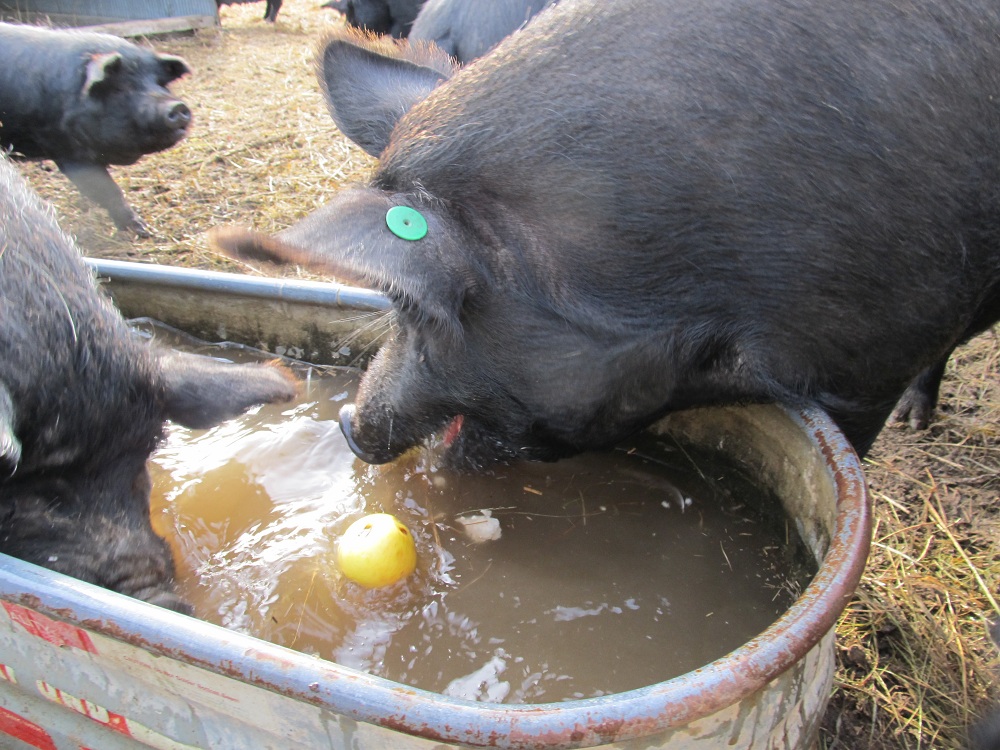
Hogs Bobbing for Apples

In an earlier post I mentioned getting a load of apples from a local orchard to feed to the pigs. Jane thought it would be fun to see if the pigs would bob for apples. You know, the way they used to do at Halloween parties back in the good ol' days.


So we pitched a couple apples in the water tank and watched.

  
 I'm not going to try it, you go first. No, you try first.

O.K. Here goes!
Success! Or the guest of honor at a luau party.
As you can see, pigs are pretty good at bobbing for apples. Who'd of thunk it.

One season of piggy salad bar pasture

Last June I wrote about what I called the "piggy salad bar" pasture mix. This was my first attempt at planting pig pasture. After reading all I could find on the subject on the internet, I planted about 1 acre of land to a mix of dwarf essex rape, oats and cow peas. Recently, I've been asked to write a little about the results of this summer's grazing. The pasture mix was grazed by our red wattle sows and gilts. I divided the pasture into three sections and the hogs were rotated to fresh pasture as the patch they were in was grazed down. All of the pigs did well and the gilts continue to grow at a good pace.As a group they ate about 25% of their normal feed ration. This made for a substantial savings on the feed bill. I have to say that overall, I was very happy with the planted pasture. I think the pigs were happy too. While I think it is fair to say that my pasture mix was a success, there are a couple of things that I will try to do differently next year. 
  • First, I will plant more ground to an annual grazing mix with staggered planting dates. This way I can rotate the hogs into fresh pasture that is not overly mature. By the time I put them on the last bit, the oats were getting a little bit tough and the cow pea pods were drying up. 
  • Second, I will try to expand the variety of things I plant. Maybe some turnips or beets for fall grazing. Or some corn to hog down. This fall, we were fortunate enough to get a couple of truck loads of pumpkins given to us. I may plant my own patch next year and let the hogs harvest them, thus eliminating all the heavy lifting!
Trailer load of pumpkins, gourds and squash for the pigs.


Guinea Hogs enjoying a couple pumpkins.
 
The vast majority of pigs today are raised in confinement buildings and fed a ration of corn and soybeans with low levels of antibiotics added to promote good heath and faster growth. This produces a fast growing hog that is profitable for the farmer and inexpensive for the consumer, but pretty much tasteless. The kind of pork you find in most supermarkets today! I firmly believe that the way to raise the best tasting pork it to raise healthy, happy hogs who get fresh air and a diet that consists of more than just corn and beans. After all, you are what your food eats!

Sunday, October 30, 2011

American Guinea Hogs

Wickham farm has been raising red wattle hogs since 2009. We currently have 6 red wattle sows/gilts, 2 red wattle boars and 5 piglets. We really love the red wattles, but are always open to something new and different. I had heard about a farm in Dell Rapids, South Dakota that specialized in preserving rare breed hogs (isn't the internet great!). After exchanging a couple of emails and phone calls, Jane and I made the long drive to Maveric Heritage Ranch in Dell Rapids, South Dakota to add American Guinea Hogs to our farm. I thought we would come home with 3 gilts and a boar. Silly me! Maveric Ranch has several lines of Guinea Hogs so choosing just a couple was very difficult. Jane picked out 8 girls and 2 boys, but Arie McFarlan, owner of Maveric Ranch made sure that the long drive was well worthwhile. Five more girls were added to the trailer so as to have a full load. We came home with 13 girls and 2 boys. An instant Guinea herd. Thanks Arie!

Our son Nick saying hello to one of our new Guinea Hogs.
 So why Guinea Hogs? The American Guinea Hog is a small black pig that is unique to the United States. The breed was popular in the United States for many years, but became nearly extinct. They are now listed as critically endangered by the ALBC. Thomas Jefferson was among those who documented early imports of the breed to the U.S. The hogs were imported to the U.S. from West Africa in conjunction with the slave trade. More info on the Guinea Hog is available at the American Livestock Breed Conservancy's website.

We feel that Guinea Hogs are ideal for the small homestead. Guinea hogs were expected to forage for their own food, eat rodents and other small animals, grass, roots and nuts, and clean out garden beds. What more could you ask for from a pig? Oh yea, what about taste? Although we haven't eaten any yet, we are also told that they taste great! Arie has entered her Guineas in many taste tests and won! Her hogs are featured on the menus of many fine restaurants across America. We hope that Wickham Farm Guineas will do so well.

Monday, October 10, 2011

Apple Time

Fall is a time when all kinds of crops are plentiful. There is a lot of food that is wasted because it is over ripe or blemished. Much of it makes good feed for our hogs. Saturday, we gathered up windfall apples for pig food. We gathered the apples from under 6 or 7 trees in no time. These would otherwise go to waste.


Big scoop for a little girl!
Just a few more buckets and the truck will be full!
This is just one more way that we try to offer our pigs a healthy and varied diet. You wouldn't want to eat the same old thing every day and neither do they. Much thanks to our friends at Indian Hills Orchard in Fulton, IL and the other farmers market vendors who have sent surplus produce home for our pigs. It makes great pork!


Friday, September 9, 2011

Making Hay

I have a sort of love/hate thing going when it comes to making hay. When everything works and the job is done, I love it. Nothing better then the smell of fresh cut hay! BUT....when its excessively hot and humid, or the equipment breaks down, or when the hay is rained on before it's put up, baling hay just plain sucks! It sucks more often than I care to remember. Thankfully, yesterday was not one of those days. It was cool and dry with temperatures in the 70's and the equipment worked as flawlessly as a bunch of antique farm equipment can. At the end of the day, I had made 27 4x4 round bales with a 1955 AC WD45 tractor and a 1970's era Vermeer 504c baler. Ancient equipment indeed, but it got the job done and it's all paid for. Ad these new bales to the 38 that I had made earlier this year and we should have more than enough for our beef cows and goats to eat this winter. Some will even go to the pigs for bedding and for munching on. Yes, pigs will eat hay. While pigs are not ruminants, they are omnivores and they will eat hay. In fact, I think they really like it.


.

Wednesday, August 31, 2011

Baby Ducklings


Muscovy hen and her ducklings


There isn't much that is cuter than a fussy little baby duckling. Mama Muscovy was parading these newly hatched ducklings around the farm this morning. She seemed pretty proud of herself! The ducks are my son Nick's project. He started off with just a couple ducks and now has more than I care to count. His hope is to be able to sell some of his flock this fall and make a little cash for himself.

Muscovy are fun to have around and they almost take care of themselves. They spend the day roaming the place catching bugs and eating grass. The Muscovy is a large duck with a lean dark meat and are the only domestic duck that is not descended from the Mallard. They are native to Mexico and Central and South America but feral populations are spreading in southern states where they can become a nuisance. Here they are just a part of the farm.